
The sham
Implied value
When the value is hidden, never delivered, or obfuscated
My father had a story from when he was in the army. His superiors gathered low-ranking soldiers and invited them for a voluntary 3-hour kitchen cleaning session. The soldiers who'd participate in this socially conscious initiative would be rewarded with potato fries; a true delicacy in the barracks of late 20th century Romanian army. No mention of how exactly would the fries be distributed, or who would cook them, or who'd be responsible for, you know, cleaning the kitchen after the fries have been cooked, or how many fries would each participant receive. My father smelled something was wrong, and decided to abstain. That turned out to be the right call.
When there is no specific extrinsic motivation displayed by your users, you might be compelled to entice them with promises of value at some point in the future. However, depending on how you word that value, or whether there is actual value to derive, users can come off feeling cheated or wary.
Tinder
Dating apps live in a somewhat liminal space, as far as UX goes. The variable reward of swiping for dating matches introduces an addictive mechanic that would go on forever if the daily limit didn't stop mindless swiping. But, like in Duolingo's case, dating apps offer tools that are meant to boost one's profile visibility.
Tinder uses an engagement tactic that rewards users for daily check-in with the app. Once every few consecutive days, you'd be rewarded with a Boost that promises to increase your visibility up to 10 times more; as in, for a set amount of time, it will get you more profile views, implying a higher chance of a match. Problem #1 is: no way for the user to measure how many views their profiles get; all you have to go on are matches, which are few, and, at least in my area, have a high chance of being fake.
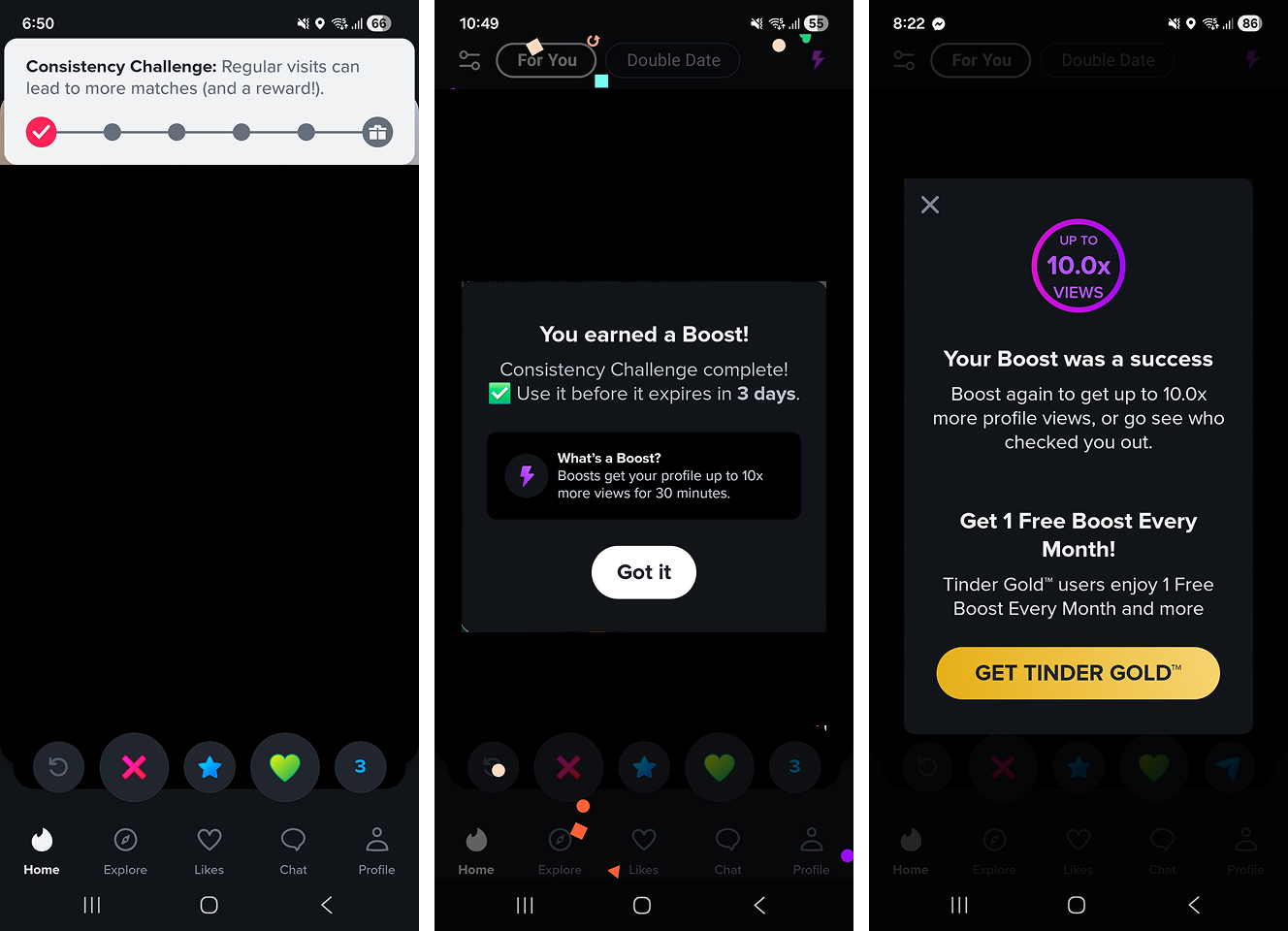
Problem #2: the Tinder user doesn't even need to engage with the platform's core functionalities (swiping and talking to matches) to unlock the Boost that implies it will do something impossible to measure. Users progress by opening the app once day, barely looking at the first visible profile, until they unlock the boost.
Insight
Don't gamify or reward actions users can't take.
Poorly balanced game mechanics tend to stack up. This is why balance is one of the most difficult tasks to accomplish in game design.
Forest
A more frequent use of gamification is through cosmetic upgrades. The productivity app Forest functions like an idle game, where the user does nothing while keeping their phone down. The app starts a timer and if the user doesn't exit the app in the allocated time, they will be rewarded with a cosmetic enhancement to their titular forest, which is a virtual patch of land with unlockable trees.
The concept is interesting; virtual currency is awarded for "productivity" to unlock more visually enticing trees. The problem with the implementation isn't just that the cosmetic upgrades have no real value (users can't brag about their lower screen time based on a virtual trees in a niche app), but that trees have asinine virtual prices that require a ton of idle engagement. An average, interesting tree costs the equivalent of 300 30-minute idle sessions, which is buck wild, coming from borked economies like *Elder Scrolls*.
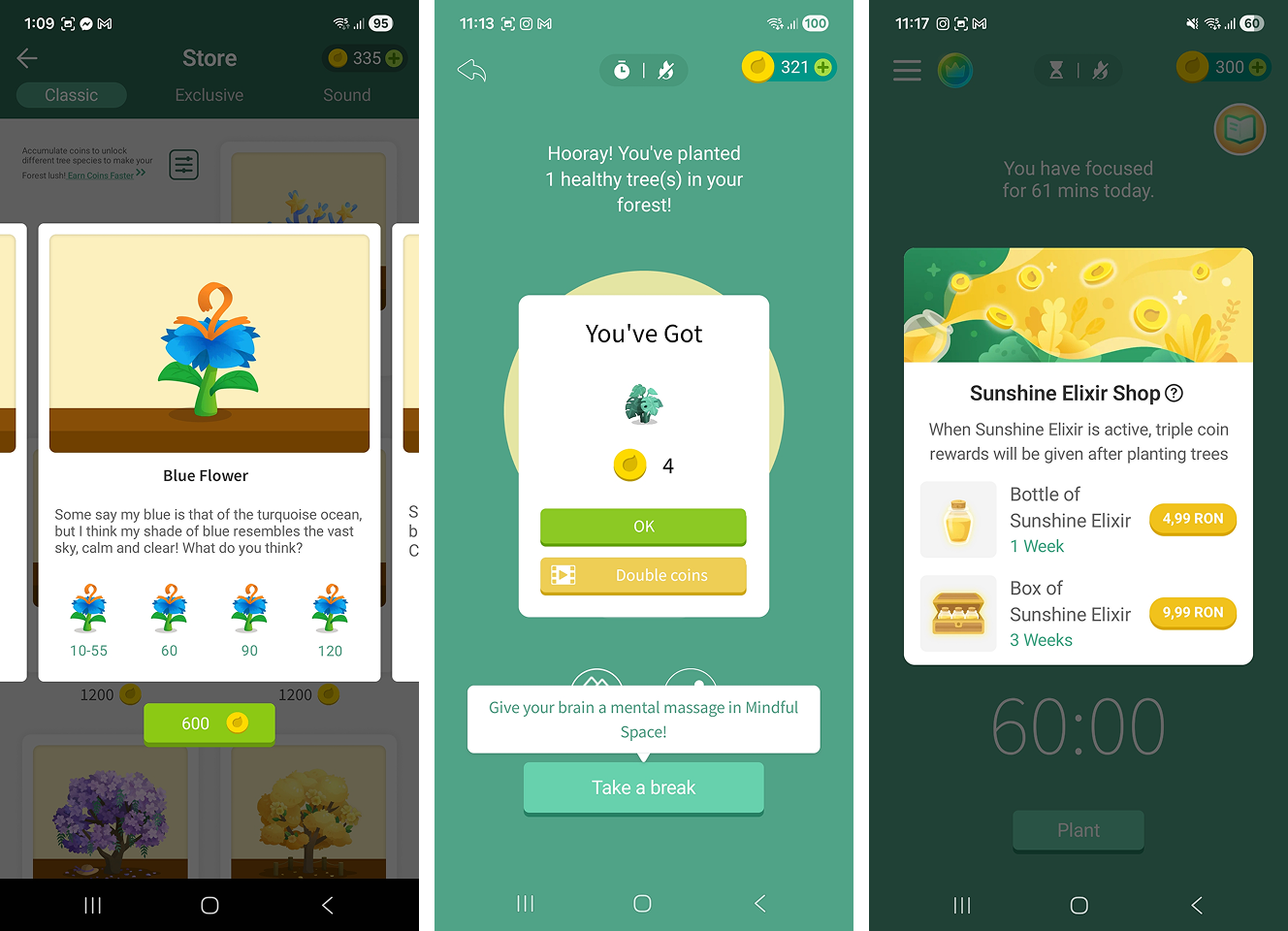
Because the user isn't explicitly shown the equivalent in minutes, they're left to connect the dots on their own: they should take shortcuts toward their desired tree by watching ads or doing longer idle sessions. In effect, it's fair to say that Forest requires you to watch ads (to double your virtual coins per session) to beautify a virtual patch of land.
Insight
Don't obscure the value of a virtual currency.
This is a problem that virtual currencies have in spades in video games and other virtual ecosystem. Designers know implicitly that if they showed the actual value of their virtual coins, people will call the system unfair and disengage.