
Framework overview
Understanding the core principles
What is gamification?
People will bring their hopes, aspirations, and levels of motivation to a digital experience. Sometimes, a user will be intrinsically motivated to engage with a product because they believe it will help them reach a specific goal. This means they'll feel an inner connection to the goal's activity, and that the feeling of ownership will boost their confidence and perceived competence.
Extrinsic motivation, on the other hand, refers to compliance, rewards, and a desire to avoid punishment. Blending the two types of motivation takes us into introjection territory, where the player regulates their self-esteem through various strategies like:
- proving they can accomplish something.
- full acceptance that, sometimes, life's lemons need to be squeezed to make juice.
Your gamification tactics can collide with their motivations in frustrating or engaging ways.
The illusion of motivation
The third important dimension is progress over time. You will get good at something due to intrinsic and extrinsic factors, but the act of making progress doesn't have to be tied to any. You can get better at wiping dishes, cooking eggs, dancing salsa, and putting sentences together, without conscious effort, or because a course is well-structured. Gamification can mark this progress, sometimes to hilarious ends.
Designers can learn to operate outside the bounds of motivation by creating features and products that don't care about what the user doesn't want to do. If, for example, I make you use a legacy B2B tool because I'm your boss, you'll use it until you find a better job. There is a perceived utility in not getting fired, even if the consequence is not directly stated. In this instance, gamification can be a good thing; it can relieve stress. But perceived utility can swing in the other direction, where the software makes a promise and never fulfills it; leaving vague breadcrumbs towards a pay-off that will never arrive.
A practical model for gamification features
Progress is closer to intrinsic motivation because more people want to get good at the things they want to do, rather than the things they feel the need to comply with. Promises of a far-fetched outcome are closer to extrinsic motivation because more people will attempt to do something sketchy (or useless) for an implicit pay-off than for no reason at all.
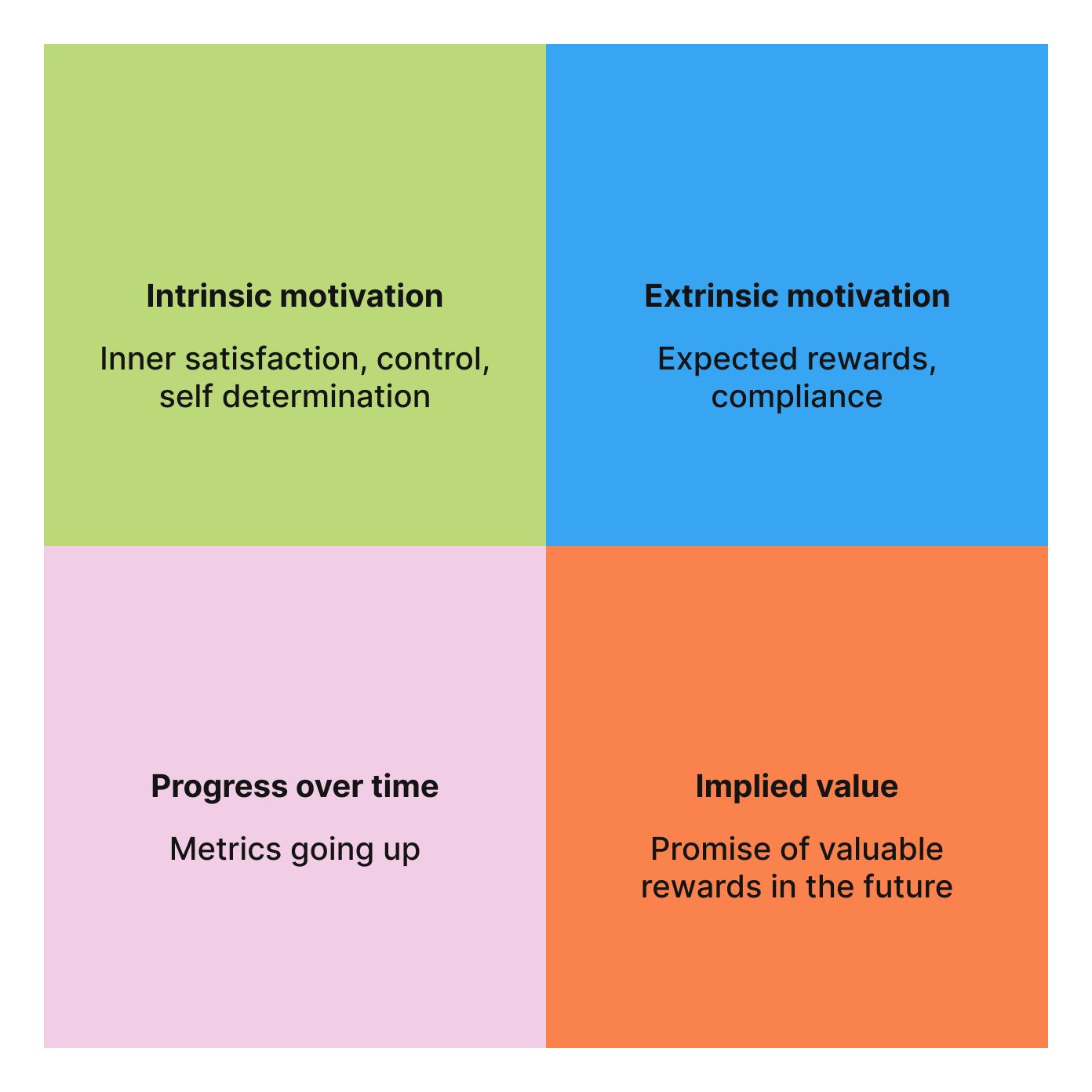
If we combine these four squares, we end up with nine quadrants; each, its own flavor of what your user brings to table when they're engaging with your product. Applying gamification to every quadrant has different results, and we'll explore all nine of them.
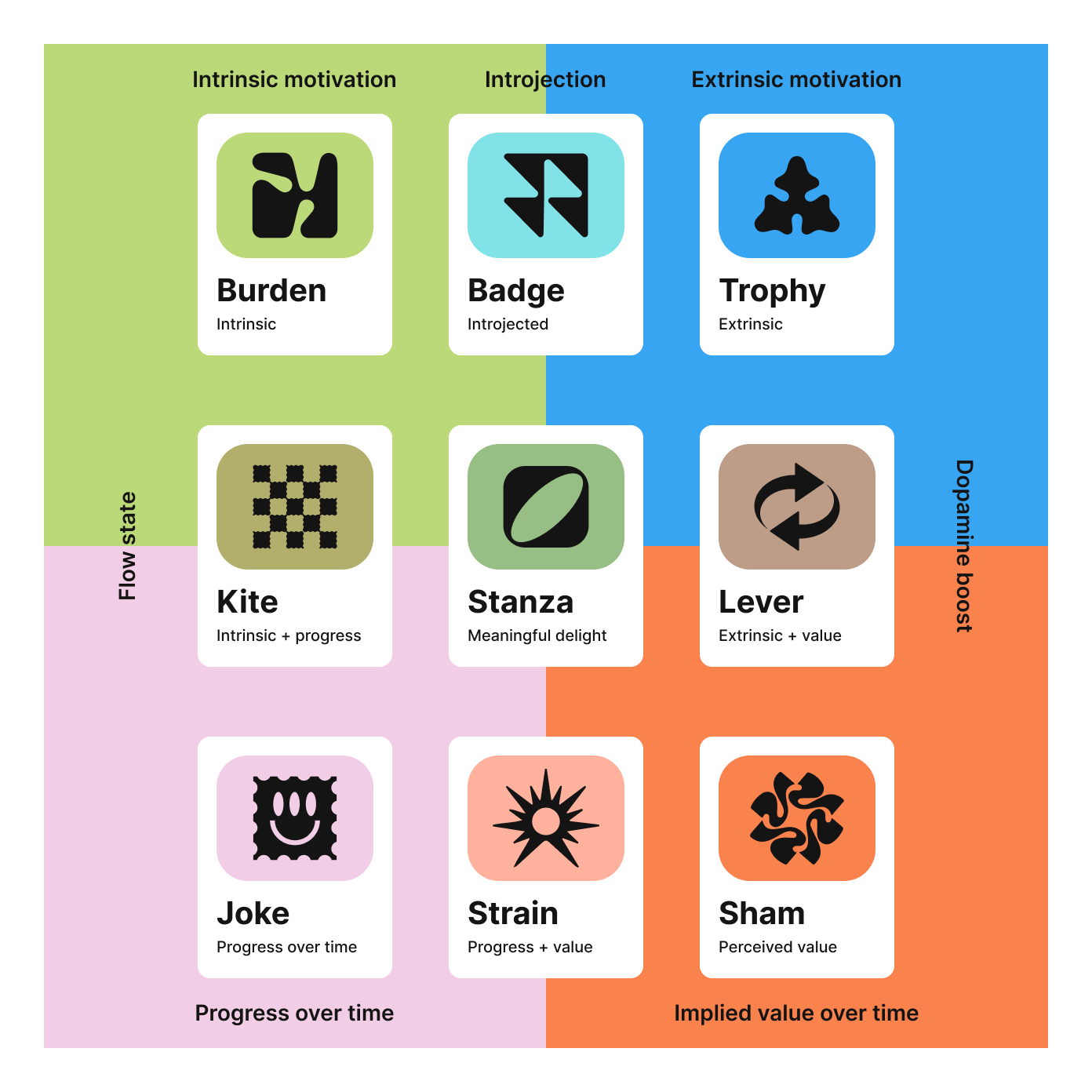
When you're designing gamification, it's important to understand the product you're making, and what the user brings to table. With this in mind, what better place to start with than the most frustrating quadrant in the 3 x 3 Gamification Matrix?