
The strain
Progress + value
When there's potential utility, so users feel compelled to grind
Remember when I said that digital products shouldn't gamify what they can't detect and measure?
Leaderboards
Let's do a quick analysis. Say you're studying the free UX design curriculum on Uxcel, or you're going through your favorite Duolingo language lesson. Eventually, you'll reach the point where you can't meaningfully progress in the leaderboard because you don't have a paid account, and have a hard limit on lessons. Since leaderboards track XP based on lessons, players who gain more XP will outrank you, rendering the leaderboard meaningless for free-tier players.
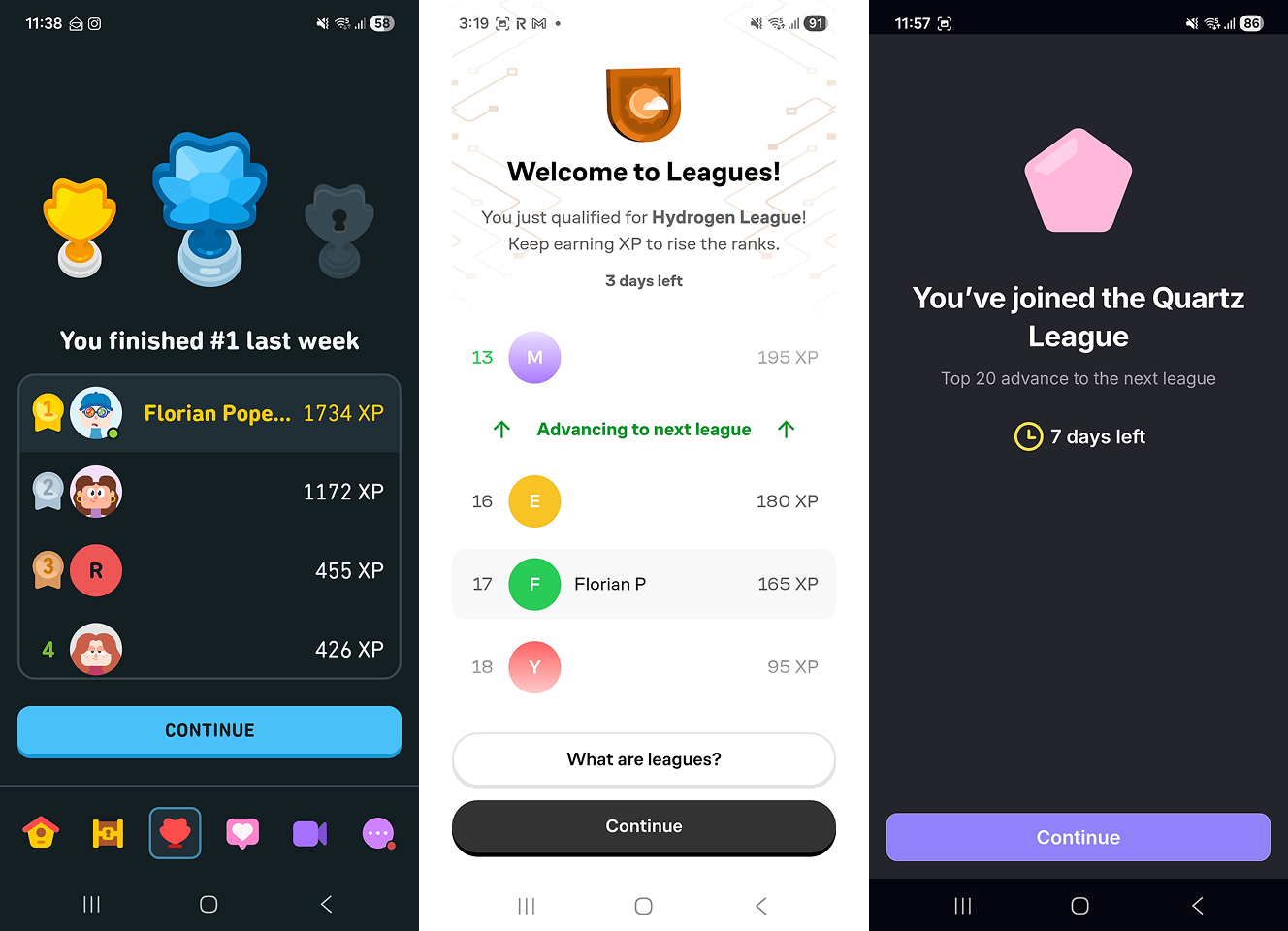
But let's evolve the logic. Say you become a paid user. (I have a Duolingo Max subscription, courtesy of one of my closest friends.) Now that you have an unlimited number of lessons, it's not required to learn anything, but to gain enough XP to beat the ranking. No product can track if I'm learning, and they can't *compare* my level of knowledge to that of the players I'm in the leaderboard with. In effect, I'm not competing with other players, but with an arbitrary number of XP points the highest-ranked player happens to hold.
Duolingo, in particular, offers specific tools that "competitive" players can abuse to gain massive amounts of XP. So a player interested in leaderboards doesn't just compete against arbitrary numbers, but against Duolingo's own unbalanced mechanics. Feeling the burnout yet?
Insight
Player remorse happens when a player realizes, to their horror, how much time they spent in a hollow game with unbalanced mechanics.
I have done my fair share of grinding in video games; i.e., doing a repetitive task on auto-pilot to get in-game rewards. I've been grinding side quests in Witcher 3 for armor, enchanted thousands of silver rings in Skyrim for Stalhrim gear, and maximized Hera's Bow to get Zagreus in bed with his lovers in Hades. But in these situations, there was an expected narrative pay-off; there was a tangible end game in sight.
Some digital products prolong the time it takes to reach the end game indefinitely. Duolingo's curriculum takes ages; I'm unsure it's even possible to complete the Spanish course in less than 2 years, and those years look to be filled with grinding repetitive word matching games and toddler-level fill-in-the-blanks sections.
Habitica
Habitica is another well-known gamification example, lauded for its integration with RPG mechanics. The app rewards you for completing tasks, habits, and dailies, with virtual currency, which you use to purchase in-game gear that customizes your character.
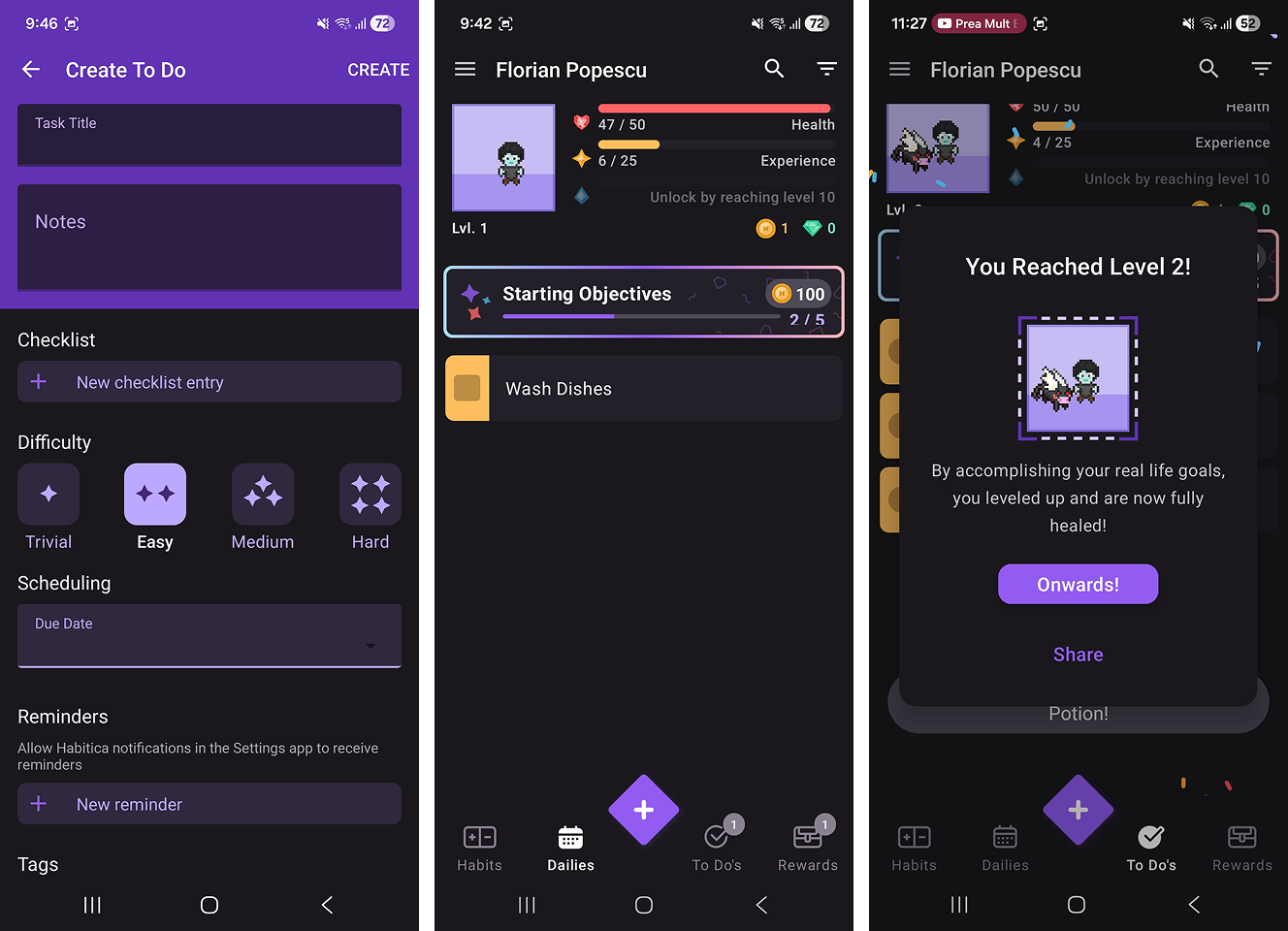
This sounds like a lot, but the gist is that everything is self-reported... except whatever you leave in the habits/ daily tab. If you don't check those off, your in-game character will take damage. This is a whole lot of work for what's meant to be a list of tasks, but productivity has seen a surge of applied game mechanics that feel just as compulsory. The result is that you end up spending more time adding and tracking your tasks than optimizing your day. So not only you feel punished for not logging your faults, but a todo list becomes Big Brother, holding a digital character hostage. The incentive created is that players can grind meaningless tasks to get their character back on track.
Insight
You should never punish the player directly with more time spent grinding.
This is tied (as everything gamification-related is) to what an app can measure. Habitica--or any other todo list--relies on self-reporting and how convenient it is to log tasks. What is supposed to happen when a user just... can't access their device?